
Student Mobility
Student Residential Mobility Networks
Clean, affordable and safer electric mobility for students living in large campuses, hostels and education hubs.
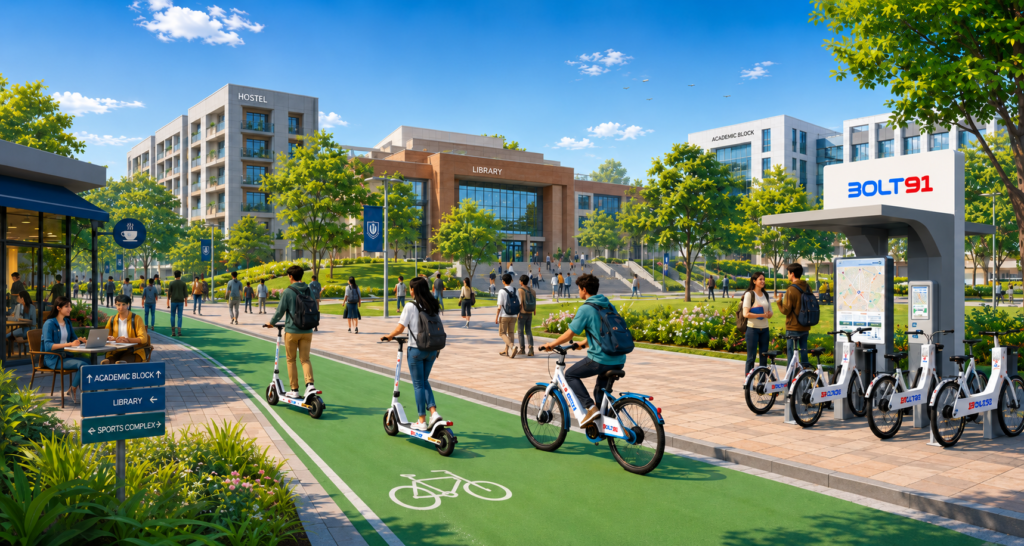
A replicable mobility model for student ecosystems where daily movement between hostels, classrooms, gates, libraries, food points and local markets is frequent, predictable and essential.
For Students Who Live Inside Large Education Ecosystems
Large campuses and education hubs are not just places of study. They are living communities.
Students move repeatedly through the day – for classes, meals, study, social life, errands and admissions-related activity.
This includes university students, hostel residents, coaching students, remote campus students, PG clusters and student housing communities.
Student Communities Need Better Daily Mobility
In many campuses and education hubs, students depend on walking, informal transport, shared rides or personal petrol vehicles for short-distance movement.
Large distances, limited internal transport and scattered facilities can make daily life inefficient, tiring and sometimes unsafe – especially during early mornings, late evenings or in remote campus areas.
Affordable electric mobility can make student ecosystems more accessible, convenient, sustainable and better organised.
Safety Matters to Parents and Institutions
For parents and campus authorities, student mobility is not only about convenience. It is also about safety, supervision and trust.
A structured electric mobility network can help reduce dependence on unmanaged transport options, support safer movement within defined areas and create a more accountable mobility layer for the campus ecosystem.
This is especially important in large residential campuses, remote academic locations and hostel clusters where students need to move every day.
A Practical Mobility Layer for Student Ecosystems
Bolt91 brings together shared electric cycles, student-friendly access points and local operating support.
The model can support hourly or daily mobility, campus movement, admissions-season trials and future EV ownership pathways.
The aim is to make student mobility clean, affordable, safer and easy to adopt without making the system complicated for institutions.
From Campus Access Points to Student Mobility Hubs
The model can use key student movement points such as hostels, academic blocks, gates, libraries, food areas, coaching clusters and student housing zones.
Mobility hubs and access points can be designed around actual student movement patterns.
The result is a structured mobility network that fits naturally into the rhythm of student life.
Built for Student Residential Ecosystems
01
Better Student Convenience
Easier daily movement across campus and nearby areas.
02
Safer, More Accountable Movement
A structured mobility layer that gives parents and authorities greater confidence.
03
Affordable Clean Mobility
Electric movement suited to student budgets and everyday needs.
04
Institution-Friendly Model
Structured deployment with local support and a clear operating framework.
05
Replicable Playbook
A model that can be adapted to other campuses, coaching hubs and student communities.
Build a Student Mobility Network
If you are connected to a university, residential campus, coaching hub, hostel network, student housing cluster or education ecosystem, Bolt91 would be happy to explore how a clean, affordable and safer mobility network can work for your community.