
TOWNSHIP Mobility
Large Township Mobility Networks
Clean, organised and safer electric mobility for large township ecosystems where people live, work, study, shop and access services within a defined area.
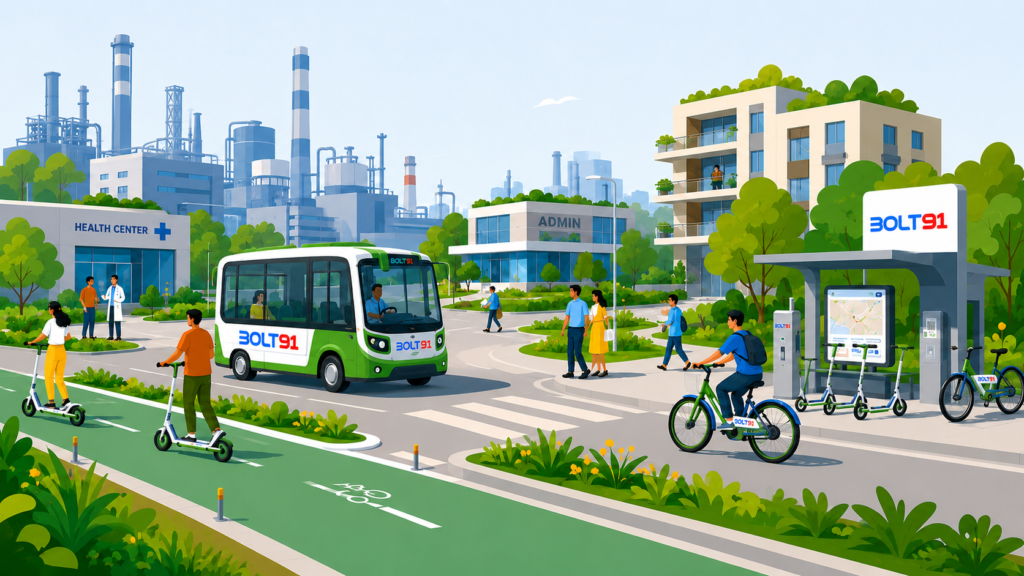
A replicable mobility model for planned townships where daily movement between residential colonies, workplaces, administrative blocks, schools, hospitals, shopping centres, guest houses and shared facilities is frequent, predictable and essential.
For Large Communities That Live and Work Together
Large townships are not just residential or work locations. They are complete living ecosystems.
Employees, families, students, supervisors, service teams, vendors and visitors move through the township every day – for work, school, healthcare, shopping, recreation, administration and daily errands.
This creates a repeated need for safe, clean and reliable internal mobility across a defined geography.
Large Townships Need Better Internal Mobility
Many large townships depend on walking, personal vehicles, staff transport, informal rides or petrol-based two-wheelers for internal movement.
As the township grows, this can create congestion, parking pressure, avoidable fuel use and uneven access for residents, workers, students and visitors.
A structured electric mobility network can make internal movement more convenient, cleaner and better organised.
Safety Matters to Families and Administrators
For township administrators, HR teams and families, internal mobility is not only about convenience. It is also about safety, reliability and trust.
A managed electric mobility network can reduce dependence on unmanaged transport options, support safer movement within defined areas and create a more accountable mobility layer for the township ecosystem.
This is especially important in large townships where people need to move every day across residential, work, education, healthcare and service zones.
A Practical Mobility Layer for Township Ecosystems
Bolt91 brings together multiple electric mobility options, township-friendly access points and local operating support.
The model can include electric cycles for everyday resident movement, kick scooters for official inter-building travel, low-speed electric scooters for controlled local movement, high-speed electric scooters for authorised longer movement and electric bus shuttles for fixed internal routes.
The aim is to make township mobility clean, reliable, safer and easy to adopt without making the system complicated for administrators or residents.
From Township Access Points to Mobility Hubs
The model can use key movement points such as residential colonies, factory or office gates, administrative blocks, schools, hospitals, shopping centres, recreation zones, guest houses and main entry points.
Mobility hubs and access points can be designed around actual township movement patterns.
The result is a structured mobility network that fits naturally into the rhythm of township life.
Built for Large Township Ecosystems
01
Better Everyday Convenience
Easier movement between homes, workplaces, schools, hospitals and community facilities.
02
Safer, More Accountable Movement
A structured mobility layer that gives families, administrators and township operators greater confidence.
03
Cleaner Internal Transport
Electric mobility helps reduce local emissions and fuel dependence inside the township.
04
Multimodal Mobility Options
Cycles, kick scooters, electric scooters and electric shuttle buses can serve different movement needs within one network.
05
Replicable Playbook
Adaptable to other Sanatan Dharma destinations and pilgrimage circuits across India.
Build a Large Township Mobility Network
If you manage or support a large township, manufacturing ecosystem, residential work community, institutional campus or self-contained community, Bolt91 would be happy to explore how a clean, organised and safer mobility network can work for your ecosystem.